
The 2026 Agentic Stack: Engineering Autonomy in the Age of Open Protocols
In 2026, the agentic stack has two distinct layers that most engineers conflate: building frameworks and deployment platforms. Here's the complete engineering map — covering LangGraph, CrewAI, OpenAI Agents SDK, AutoGen, LlamaIndex, ADK, and every managed platform worth knowing.
Why "Chatbots" Died in 2025
Cast your mind back to 2023. The dominant pattern was embarrassingly simple: user sends text → LLM generates text → user reads text. We called them "assistants." We called them "copilots." We called them, optimistically, "the future of work."
They were, in retrospect, very expensive autocomplete.
The death blow came not from a single model breakthrough but from an architectural reckoning: production teams discovered that autonomous action — not generation — was the unlock. An agent that could open a browser, query a database, call an API, receive the result, reason about it, and then take the next action without a human in the loop for every step? That was the real primitive.
By late 2025, the taxonomy had shifted permanently. We stopped talking about "prompts" and started talking about workflows, state machines, tool registries, and inter-agent protocols. And critically, the stack split into two distinct concerns that are often conflated but shouldn't be:
- Building: Which framework do you use to define agent logic, memory, and coordination?
- Deploying: Which managed platform hosts, scales, and monitors your agents in production?
Mixing these up leads to bad architectural decisions. This post separates them — and maps the full 2026 stack from first principles. We'll go layer by layer: Orchestration Frameworks → Deployment Platforms → Protocols. By the end, you'll have a decision framework for your own architecture, and a strong opinion about which combination wins for your use case.
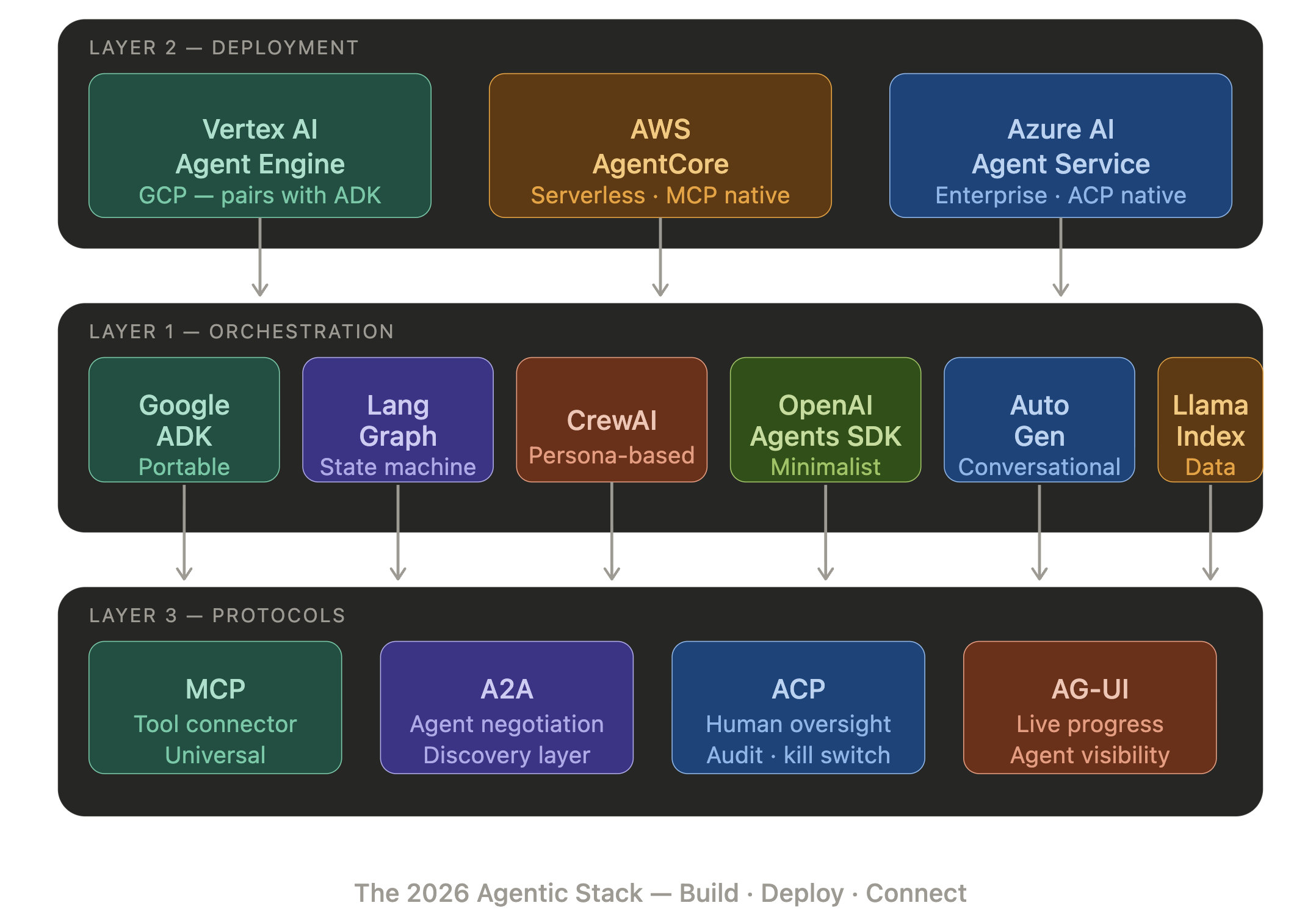
Layer 1: Orchestration Frameworks — Where Agent Logic Lives
Before you think about clouds and managed services, you need to answer a more fundamental question: how does your agent think? The orchestration framework defines your agent's memory model, its tool-calling strategy, how multiple agents coordinate, and crucially — how you debug it when it misbehaves in production.
In 2026, there are five serious contenders, each representing a distinct philosophy.
Google ADK: The Portable, Code-First Standard
Google Agent Development Kit (ADK) is Apache 2.0 licensed, Python-native, and built around one core principle: your agent logic should be portable across any runtime. ADK handles the plumbing — tool registration, memory management, session state, streaming — so you're writing business logic, not infrastructure code.
Think of it as what Kubernetes did for containers: abstract the runtime away so your application stays clean. ADK agents can run on GCP, on your own servers, or on a competitor's cloud. That's a philosophy, not an accident. It also integrates natively with Google's Vertex AI Agent Engine for managed deployment (more on that in Layer 2).
Best for: Teams who want cloud portability as a first-class requirement, Python-native developers, and anyone building something that may need to run on-prem someday.
The honest tradeoff: ADK gives you control but not a safety net. You own scaling, observability, and uptime unless you pair it with a managed deployment layer.
LangGraph: Deterministic State Machines for Serious Workloads
LangGraph treats agent behavior as a directed graph where nodes are computation steps and edges are conditional transitions. This sounds academic until you're debugging a production incident at 2am and you need to know exactly which state your agent was in when it made the wrong tool call.
Its defining features are cyclic graph support (agents loop back to previous states based on outcomes) and "Time Travel" debugging — the ability to snapshot agent state at any checkpoint and replay from that point forward. For anyone who's tried to reproduce a flaky agent failure without this, the value is immediately obvious. The Studio UI adds a visual graph editor and real-time state inspector.
Best for: Finance, legal, and healthcare workloads where every decision needs an audit trail. Any domain where "what did this agent do and why?" must have a clear, reproducible answer.
The honest tradeoff: LangGraph's explicitness is its superpower and its friction. You're writing explicit state schema definitions upfront — intentionally more code than higher-abstraction frameworks.
CrewAI: Collaborative Multi-Agent Systems
CrewAI models agents as role-bearing actors in a collaborative system. You define a crew — a Researcher, a Writer, an Editor, a Fact-Checker — assign each a role, backstory, and toolset, describe the goal, and CrewAI figures out the delegation. The A2A (Agent-to-Agent) protocol, covered in Layer 3, is where CrewAI agents do their best work: negotiating sub-tasks and passing context between specialized agents without explicit programmer choreography.
Best for: Content pipelines, market research, product development, and any domain where the "right" process is fuzzy and you want agents to figure it out.
The honest tradeoff: Emergent behavior is a feature and a bug. CrewAI can find creative solutions you didn't anticipate — and occasionally take creative detours you also didn't anticipate. Not for high-stakes deterministic workflows.
OpenAI Agents SDK: The Minimalist, Model-Native Approach
OpenAI's Agents SDK is the leanest framework in this lineup. It's built around three primitives: Agents (an LLM with instructions and tools), Handoffs (structured delegation from one agent to another), and Guardrails (input/output validation that runs in parallel without blocking the main agent loop).
The design philosophy is intentional minimalism — no state machine complexity, no persona definitions, just clean Python that maps directly to how the OpenAI API works. The Responses API integration means your agents can consume and produce structured data natively, which dramatically simplifies tool calling and result parsing. Tracing is built in, with every agent run captured for debugging.
Best for: Teams already invested in OpenAI's model ecosystem, rapid prototyping, and workloads where simplicity and fast iteration beat framework sophistication. Also the right choice if you're building on top of GPT-4o's native tool use capabilities.
The honest tradeoff: The minimalism that makes it fast to start becomes a constraint at scale. Complex multi-agent orchestration, long-running state management, and advanced debugging require reaching for additional abstractions. It's also inherently model-coupled — switching away from OpenAI models requires more rewriting than with model-agnostic frameworks.
AutoGen (Microsoft): Conversational Multi-Agent Research
Microsoft's AutoGen pioneered the conversational multi-agent pattern — agents that solve problems through structured dialogue with each other, rather than explicit state machines or role-based delegation. AutoGen v0.4 matured this significantly with an event-driven, actor-model architecture that makes agent interactions more predictable and composable.
The framework introduces AssistantAgent and UserProxyAgent as the core interaction pair, but its real strength is the GroupChat abstraction — a managed conversation space where multiple specialized agents collaborate, debate, and converge on solutions. This makes AutoGen particularly powerful for tasks that genuinely benefit from multiple reasoning perspectives: code review, complex analysis, and research synthesis.
AutoGen integrates naturally with Azure AI services and the broader Microsoft ecosystem, making it the de facto choice for teams building on Azure OpenAI. The new AutoGen Studio provides a no-code interface to prototype multi-agent workflows, which lowers the barrier for non-engineers to experiment.
Best for: Research, code generation, complex analysis tasks that benefit from agent debate, and teams in the Azure/Microsoft ecosystem.
The honest tradeoff: AutoGen's conversational model can produce verbose, unpredictable interaction patterns that are hard to audit in production. It's a research-to-production framework — excellent for exploring what's possible, requiring more disciplined structuring for reliable deployed systems.
LlamaIndex: The Data-First Agent Framework
LlamaIndex occupies a unique position: it's the only major framework that treats data connectivity as the primary concern rather than agent orchestration. Where other frameworks start with "how does the agent think?", LlamaIndex starts with "how does the agent know?"
Its LlamaHub ecosystem provides hundreds of pre-built data connectors — vector stores, document loaders, graph databases, APIs — that agents can query through a unified interface. The Workflows abstraction (introduced in late 2024) added proper event-driven orchestration on top of this data layer, making LlamaIndex competitive as a full agent framework rather than just a RAG toolkit.
The QueryEngine and SubQuestionQueryEngine patterns are particularly powerful for agentic RAG — breaking complex questions into sub-queries, running them in parallel against different data sources, and synthesizing the results. No other framework matches LlamaIndex's depth here.
Best for: Knowledge-intensive applications, enterprise RAG pipelines, agents that need to reason over large document corpora, and any workload where data access patterns are the core engineering challenge.
The honest tradeoff: LlamaIndex's data-first orientation means its agent orchestration capabilities are less mature than LangGraph or CrewAI for complex multi-agent coordination. It's best thought of as a data layer that gained orchestration capabilities, rather than an orchestration framework that handles data well.
The 2026 Orchestration Framework Decision Matrix
Use this when you're choosing your building layer. These are frameworks for writing agent logic — not deployment platforms.
| Dimension | Google ADK | LangGraph | CrewAI | OpenAI Agents SDK | AutoGen | LlamaIndex |
|---|---|---|---|---|---|---|
| Logic Model | Code-First | State Machine | Persona-Based | Minimalist / Handoffs | Conversational | Data-First / Workflows |
| Open Source? | ✅ Apache 2.0 | ✅ MIT | ✅ MIT | ✅ MIT | ✅ MIT | ✅ MIT |
| Multi-Agent? | Yes (subagents) | Yes (subgraphs) | Yes (crews) | Yes (handoffs) | Yes (groupchat) | Partial |
| Debuggability | High | Very High (Time Travel) | Low (emergent) | Medium (tracing built-in) | Medium | Medium |
| Model Agnostic? | ✅ Yes | ✅ Yes | ✅ Yes | ❌ OpenAI-native | Mostly (Azure-preferred) | ✅ Yes |
| Best Strength | Portability | Reliability | Autonomy | Speed to market | Research/Analysis | Data connectivity |
| Learning Curve | Medium | High | Low | Very Low | Medium | Medium |
Layer 2: Deployment Platforms — Where Agents Run in Production
Once you've built your agent logic, you face an entirely separate set of decisions: how do you run it reliably at scale, with proper observability, memory persistence, and security controls? This is the deployment layer — and it's where the major cloud providers are now competing aggressively.
The critical insight: deployment platforms are largely framework-agnostic. You can run a LangGraph agent on Vertex AI Agent Engine. You can deploy a CrewAI workflow on Azure AI Agent Service. The framework you choose for building doesn't lock you into a particular deployment platform — though some pairings are more natural than others.
Google Vertex AI Agent Engine
Vertex AI Agent Engine is Google's fully managed runtime for production agents. It handles the operational concerns that ADK deliberately leaves to you: autoscaling, session management, memory persistence, and monitoring via Cloud Trace and Cloud Logging.
The natural pairing is ADK + Agent Engine — you build with ADK's portable framework and deploy onto Agent Engine's managed infrastructure. But Agent Engine is runtime-agnostic; it can host LangGraph and other framework agents equally well. Key capabilities include persistent agent sessions (agents can resume long-running tasks across API calls), managed tool execution (sandboxed code execution and API calls), and native integration with Vertex AI's model garden for model access.
Best for: GCP-native teams, ADK users who want managed deployment, and workloads needing persistent long-running sessions.
The honest tradeoff: GCP commitment is real. Agent Engine's deepest capabilities tie to Google's data and model ecosystem. Multi-cloud architectures require deliberate effort.
AWS AgentCore
AWS AgentCore is built on the same serverless primitives as Lambda but purpose-built for agent workloads. The headline feature is elastic scaling: agents scale to zero when idle and burst to handle thousands of concurrent sessions without you touching an autoscaling policy — critical for event-driven agentic workloads with unpredictable traffic patterns.
AgentCore integrates natively with Bedrock for model access, S3 for memory and artifact storage, and CloudWatch for observability. It also supports the MCP protocol natively for tool connectivity, making it one of the first managed platforms to treat open protocols as a first-class deployment concern. IAM-based security means your existing AWS access controls apply directly to agent permissions.
Best for: AWS-native organizations, burst workloads with variable traffic, and teams that want to leverage existing IAM/VPC infrastructure for agent security.
The honest tradeoff: Vendor lock-in is real. Migrating agent state, memory stores, and tool configurations out of AgentCore is a non-trivial migration project. Evaluate this before you commit.
Azure AI Agent Service
Azure's managed agent platform is inseparable from its enterprise integration story. Azure AI Agent Service shines brightest when your agents need to interact with Teams, SharePoint, Outlook, or Dynamics — which in most large enterprises means nearly everything.
Azure's ACP (Agent Control Protocol) implementation is the most enterprise-mature in the market, with native approval workflows surfaced through Teams and full audit logging to Azure Monitor. This makes it the natural choice for regulated industries where human-in-the-loop controls and compliance trails are non-negotiable. AutoGen's deep Azure integration means Microsoft's own orchestration framework deploys here with minimal friction.
Best for: Enterprise environments running Microsoft's productivity stack, regulated industries needing audit trails and approval workflows, and teams already on Azure OpenAI Service.
The honest tradeoff: Local development experience lags behind GCP and AWS. The developer ergonomics are improving but the Azure portal-heavy workflow still frustrates engineers used to code-first tooling.
The Deployment Platform Decision Matrix
| Dimension | Vertex AI Agent Engine | AWS AgentCore | Azure AI Agent Service |
|---|---|---|---|
| Scaling Model | Managed / Auto | Serverless / Zero-scale | Managed / Enterprise |
| Natural Framework Pairing | Google ADK | Framework-agnostic | AutoGen / Any |
| Protocol Support | MCP, A2A | MCP native | ACP (best-in-class) |
| Human-in-the-Loop | Via Cloud Tasks | Via Step Functions | Native (Teams integration) |
| Compliance/Audit | Good (Cloud Logging) | Good (CloudWatch) | Best-in-class (ACP + Monitor) |
| Best For | GCP-native / Open builds | Burst workloads / AWS-native | Enterprise / M365 integration |
| Lock-in Risk | Medium | High | High |
Layer 3: The Nervous System — Open Protocols
This is the layer most engineering blog posts skip entirely, and it's where the real competitive moats are being built in 2026. The frameworks and platforms above are all capable. What differentiates mature agentic systems from sophisticated demos is the protocol layer — the standardized communication contracts that let agents talk to tools, talk to each other, and talk to humans safely.
The four protocols you need to understand:
MCP — Model Context Protocol: The Universal Tool Connector
Before MCP, connecting an agent to a data source meant writing a custom integration every time: custom auth handling, custom response parsing, custom error handling, custom schema translation. Multiply that by every tool your agent needed, and you had an unmaintainable integration layer.
MCP standardizes this entirely. Define a tool as an MCP server, and any MCP-compatible runtime — ADK, LangGraph, the OpenAI Agents SDK, whatever comes next — can discover and call it without custom glue code. The practical impact: a growing ecosystem of community-built MCP servers for Postgres, Slack, Google Drive, GitHub, Linear, and dozens more. Your agents get new capabilities without your team writing integration code.
MCP operates on a client-server model. The protocol handles capability discovery (what tools exist), invocation (call this tool with these parameters), and response streaming (handle partial results). Critically, MCP servers can also expose resources — read-only data sources like databases or file systems — not just callable functions, which enables richer context injection without direct data access.
# Connecting any agent framework to multiple MCP servers
from langchain_mcp_adapters.client import MultiServerMCPClient

client = MultiServerMCPClient({
    "postgres": {"url": "http://localhost:8001/mcp"},
    "slack":    {"url": "http://localhost:8002/mcp"},
    "drive":    {"url": "http://localhost:8003/mcp"},
})

tools = await client.get_tools()
# These tools now work in LangGraph, CrewAI, ADK — any compatible framework
A2A — Agent-to-Agent Protocol: The Negotiation Layer
As multi-agent systems matured, a new problem emerged: how do agents coordinate without a central orchestrator micromanaging every interaction? A2A is Google's answer — a protocol for agents to discover each other's capabilities, negotiate task delegation, and pass structured context without hard-coded wiring between them.
The canonical example: a travel booking system with a Calendar Agent and a Flight Agent. The user says "find me a flight to Mumbai next week that doesn't conflict with my meetings." With A2A, the Calendar Agent discovers the Flight Agent via an Agent Registry, negotiates the constraint ("I'm blocked Monday and Thursday"), and the Flight Agent responds with compliant options. Neither agent was programmed to know about the other upfront — the protocol handles discovery and negotiation dynamically.
A2A uses a JSON-based message envelope with standardized fields for capability declarations, task descriptions, context payloads, and response schemas. CrewAI's inter-agent communication is the most mature production implementation today.
ACP — Agent Control Protocol: The Human-in-the-Loop Kill Switch
ACP addresses the hardest unsolved problem in production agentic systems: how do you maintain meaningful human oversight over agents taking real-world actions with real consequences?
ACP defines three primitives every production system needs: Approval Gates (specific action types — "send email," "execute trade," "delete record" — require human approval before execution; the agent suspends and waits), Audit Logs (every action logged with full context: which model, which tool, which input, which output, timestamp, and the reasoning chain), and Circuit Breakers (anomaly detection that halts agent execution when behavior deviates from expected bounds).
Azure's ACP implementation is the most enterprise-ready today. The open spec is gaining adoption across other platforms. Implement this from day one — retrofitting oversight into an existing agent system is significantly more painful than building it in from the start.
AG-UI — Agent-Graphic User Interface: Making Agent Work Visible
AG-UI solves a surprisingly important UX problem: agents do complex, multi-step work that's invisible to users. A user asks an agent to "research competitors and draft a report" — the agent makes 40 tool calls over 3 minutes. Without AG-UI, the user stares at a spinner and wonders if something broke.
AG-UI defines a protocol for agents to emit structured UI events that client applications render as dynamic progress canvases: live tables of data being gathered, a document outline populating in real time, a checklist of completed steps. Think of it as Server-Sent Events for agent cognition, with a standardized schema any frontend can consume. The agent communicates its work as it happens, not just when it finishes.
Putting It Together: The Winning Architecture for 2026
The two-layer mental model — building vs. deploying — is the organizing principle for a coherent 2026 agentic stack. Here's how the pieces compose:
For reliability-critical workloads (finance, healthcare, legal): Build in LangGraph for explicit state machines and Time Travel debugging. Connect tools via MCP. Deploy on Vertex AI Agent Engine or AWS AgentCore depending on your cloud home. Implement ACP approval gates and audit logs from day one. Don't compromise on the determinism.
For creative and research workloads (content, market research, analysis): Build in CrewAI or AutoGen for collaborative multi-agent dynamics. Use A2A for inter-agent negotiation. Deploy on whichever managed platform fits your cloud. Accept that emergent behavior is a feature here.
For knowledge-intensive applications: LlamaIndex as your data layer, combined with LangGraph or ADK for orchestration on top. This combination gives you unmatched data connectivity plus production-grade agent reliability.
For rapid prototyping and OpenAI-native teams: OpenAI Agents SDK to move fast, with a clear migration path to LangGraph or ADK when operational requirements demand more control.
For enterprise Microsoft environments: AutoGen for orchestration, Azure AI Agent Service for deployment, ACP for compliance. The integration depth with M365 makes this the only practical choice for large enterprise deployments.
The Bigger Picture
The "Orchestration Wars" of 2026 aren't being fought over model benchmarks. MMLU scores are table stakes. The real competition is over who builds the most reliable, interoperable, and auditable agentic infrastructure — and who does it on open standards that don't create new vendor moats.
Open protocols (MCP, A2A, ACP, AG-UI) are the most important infrastructure development since the Transformer architecture. They create a composable ecosystem where agent capabilities can be shared, tools can be standardized, and oversight can be systematized — rather than every team reinventing every wheel inside a closed, proprietary system.
The engineers who win the next two years won't be the ones who fine-tuned the best model. They'll be the ones who built the most robust agent pipelines on open standards, with clear failure modes, reproducible behavior, and humans appropriately in the loop.
That's not a prediction. That's already happening. The question is just whether you're building it.
Further Reading & Resources
- Google ADK on GitHub — Reference implementation and getting started guides
- LangGraph on GitHub — Core framework, examples, and Studio docs
- CrewAI on GitHub — Framework and A2A implementation examples
- OpenAI Agents SDK on GitHub — Minimalist agent framework with built-in tracing
- AutoGen on GitHub — Microsoft's conversational multi-agent framework
- LlamaIndex on GitHub — Data-first agent framework and LlamaHub connector ecosystem
- Model Context Protocol GitHub Org — MCP spec and community server registry
- A2A Protocol Spec — Google's open Agent-to-Agent protocol specification