
The Production Reality — Governance, Security, and ROI for RAG Systems in 2026
Part 5 of the RAG Series: The unglamorous work that keeps RAG alive in production. EU AI Act obligations, RBAC at the retrieval layer, provenance tracking, and an ROI framework that makes the business case concrete.
This is Part 5 — the final post — of a 5-part series on building production-grade RAG systems in 2026. Previous parts: Part 1, Part 2, Part 3, Part 4.
The Systems That Get Quietly Killed
There's a graveyard of excellent RAG prototypes inside large organisations. The ingestion was clean. The retrieval was hybrid. The LangGraph architecture was elegant. And six months after launch, the system was quietly decommissioned — not because it didn't work technically, but because it couldn't satisfy a compliance review, or a junior analyst accidentally retrieved documents they weren't authorised to see, or no one could articulate its value relative to its cloud bill.
Governance, security, and ROI aren't afterthoughts — they're what determines whether a RAG system survives contact with a real organisation. This post is about building those foundations in from the start.
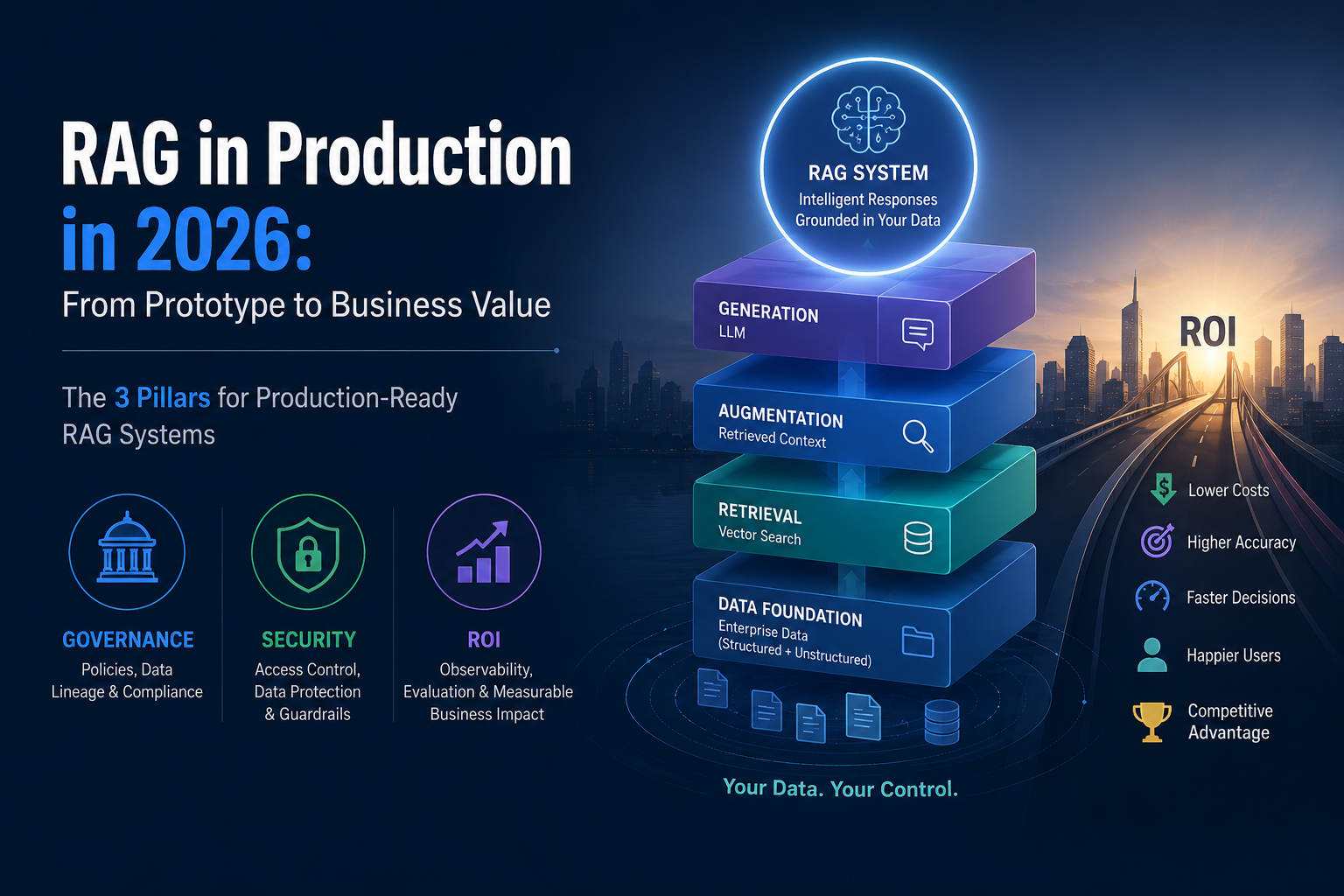
I. Regulatory Alignment: The EU AI Act in Practice
The EU AI Act became fully applicable on 2 August 2026. For RAG systems deployed in Europe — or by European organisations — the key obligations that apply are around transparency, provenance tracking, and audit trails. Specifically: the system must be able to explain why it gave a particular answer, and trace that answer back to authorised source documents.
This is actually good engineering practice regardless of compliance requirements. The mechanism is provenance tracking: every generated response carries metadata about which chunks it was grounded in, which documents those chunks came from, and who was responsible for those documents.
from datetime import datetime, timezone
from langchain_core.documents import Document
from langchain_openai import ChatOpenAI
from langchain_core.prompts import ChatPromptTemplate
import hashlib
import json

def generate_with_provenance(
    question: str,
    retrieved_docs: list[Document],
    llm: ChatOpenAI,
) -> dict:
    """
    Generate an answer and produce a full provenance record.
    The provenance record satisfies EU AI Act audit trail requirements
    and supports post-hoc explanation of any response.
    """
    context = "\n\n".join(d.page_content for d in retrieved_docs)

    prompt = ChatPromptTemplate.from_messages([
        ("system", "Answer the question based only on the provided context. Be precise and cite which source supports each claim."),
        ("human", "Context:\n{context}\n\nQuestion: {question}"),
    ])

    answer = (prompt | llm).invoke({"context": context, "question": question}).content

    # Build provenance record — store this alongside every response
    provenance = {
        "timestamp": datetime.now(timezone.utc).isoformat(),
        "question": question,
        "answer": answer,
        "answer_hash": hashlib.sha256(answer.encode()).hexdigest(),

        # Source traceability — maps answer back to authorised documents
        "sources": [
            {
                "source_file": doc.metadata.get("source_file"),
                "section": doc.metadata.get("section"),
                "chunk_hash": doc.metadata.get("content_hash"),
                "ingested_at": doc.metadata.get("ingested_at"),
                "doc_summary": doc.metadata.get("doc_summary"),
            }
            for doc in retrieved_docs
        ],

        # System metadata for audit
        "model": "gpt-4o",
        "pipeline_version": "1.2.0",   # Version your pipeline — important for regression tracking
        "retrieval_strategy": "hybrid_bm25_vector",
    }

    return {"answer": answer, "provenance": provenance}


# Store provenance in a tamper-evident log (append-only, timestamped)
def log_provenance(provenance: dict, log_path: str = "provenance_log.jsonl"):
    """Append provenance record to an audit log. JSONL = one JSON object per line."""
    with open(log_path, "a") as f:
        f.write(json.dumps(provenance) + "\n")
The answer_hash is particularly important: it creates a verifiable fingerprint of the response at the time it was generated, so you can prove (e.g., in a legal or regulatory context) that the response hasn't been modified after the fact.
Beyond provenance, the Act's GPAI obligations — applicable since August 2025 — require that documentation be retained for at least 10 years and made available to the AI Office on request. Design your log storage with this retention window in mind from day one.
II. Access Control: Users Only Find What They're Authorised to See
This is the most common production security failure in RAG systems: a user asks about "Project Athena" and the system retrieves confidential executive documents because everything was indexed with the same permissions. Vector search doesn't know about your organisation's access hierarchy. You have to enforce it explicitly.
The fix is metadata-based access control at the retrieval layer — every document chunk carries the user roles authorised to access it, and the retriever filters by these roles before returning any results.
from langchain_community.vectorstores import Chroma
from langchain_openai import OpenAIEmbeddings
from langchain_core.documents import Document
from typing import List

# During ingestion — tag every chunk with its authorised roles
def ingest_with_acl(doc: Document, authorised_roles: List[str]) -> Document:
    """
    Add role-based access control metadata to every document chunk.
    authorised_roles: e.g. ["analyst", "manager", "executive"]
    """
    doc.metadata["authorised_roles"] = authorised_roles
    doc.metadata["acl_hash"] = hashlib.md5(
        json.dumps(sorted(authorised_roles)).encode()
    ).hexdigest()
    return doc

# Example: ingest with tiered access
executive_doc = ingest_with_acl(
    board_minutes_chunk,
    authorised_roles=["executive", "board"],
)
general_doc = ingest_with_acl(
    hr_policy_chunk,
    authorised_roles=["all_staff"],
)

vectorstore = Chroma.from_documents(
    [executive_doc, general_doc],
    OpenAIEmbeddings(),
)


# During retrieval — filter by the current user's roles
def get_authorised_retriever(user_roles: List[str], vectorstore: Chroma):
    """
    Return a retriever that only surfaces documents the user is authorised to see.
    This is enforced at the retrieval layer — the LLM never receives unauthorised context.
    """
    # Chroma supports $in operator for list membership filtering
    # This filters to documents where any of the user's roles appears in authorised_roles
    authorised_retriever = vectorstore.as_retriever(
        search_kwargs={
            "k": 5,
            "filter": {
                "authorised_roles": {"$in": user_roles + ["all_staff"]}
            }
        }
    )
    return authorised_retriever


# Usage — enforce per-user access on every query
def query_with_rbac(question: str, user_roles: List[str]) -> str:
    retriever = get_authorised_retriever(user_roles, vectorstore)
    docs = retriever.invoke(question)

    if not docs:
        return "I don't have authorised information to answer that question."

    result = generate_with_provenance(question, docs, llm)
    log_provenance(result["provenance"])
    return result["answer"]


# Analyst gets only their tier
analyst_answer = query_with_rbac(
    "What were the Q3 board decisions?",
    user_roles=["analyst"]
)
# → "I don't have authorised information to answer that question."

# Executive gets the full picture
executive_answer = query_with_rbac(
    "What were the Q3 board decisions?",
    user_roles=["executive", "board"]
)
# → Full answer from board minutes
Three important implementation notes. First, the ACL filtering happens before the LLM sees any context — the model is never shown unauthorised documents, even partially. Second, all access attempts (including failed ones) should be logged — this is required for audit purposes and useful for detecting unusual access patterns. Third, when a user's roles change (promotion, offboarding), re-tag the documents in your index accordingly — stale ACL metadata is a security vulnerability.
III. The PII Problem
A specific sub-case of access control that deserves dedicated attention: personally identifiable information in your index. Customer records, employee data, and medical information are commonly embedded into enterprise RAG systems without adequate controls. Once a value is embedded and indexed, blocking it downstream is unreliable. The fix is explicit PII redaction before embedding.
import re
from langchain_core.documents import Document

# Simple PII patterns — use a dedicated library (e.g. Microsoft Presidio) for production
PII_PATTERNS = {
    "email": r"\b[A-Za-z0-9._%+-]+@[A-Za-z0-9.-]+\.[A-Z|a-z]{2,}\b",
    "phone": r"\b(\+\d{1,3}[-.\s]?)?\(?\d{3}\)?[-.\s]?\d{3}[-.\s]?\d{4}\b",
    "pan_card": r"\b[A-Z]{5}[0-9]{4}[A-Z]{1}\b",   # Indian PAN
    "aadhaar": r"\b\d{4}\s\d{4}\s\d{4}\b",           # Indian Aadhaar
}

def redact_pii(doc: Document) -> Document:
    """Redact PII before embedding. Call this before enrich_documents()."""
    text = doc.page_content
    for pii_type, pattern in PII_PATTERNS.items():
        text = re.sub(pattern, f"[REDACTED_{pii_type.upper()}]", text)
    doc.page_content = text
    doc.metadata["pii_redacted"] = True
    return doc
For production, use Microsoft Presidio or a similar dedicated library — the regex patterns above are illustrative, not exhaustive. The key discipline is: redact before embed, not after.
IV. ROI Framework: Making the Business Case
A RAG system that can't justify its cost will be shut down. The ROI calculation for enterprise RAG is more tractable than it might seem, because the primary value driver is quantifiable: reduction in search-to-decision time.
Before your RAG system, a knowledge worker searching for policy information might spend 15–45 minutes navigating a sprawling intranet, emailing colleagues, and reading irrelevant documents. After deployment, the same query resolves in under 30 seconds. Multiply that time saving across your user base and annual query volume, and the economics become clear.
def calculate_rag_roi(
    daily_queries: int,
    users: int,
    avg_search_time_before_minutes: float,
    avg_search_time_after_seconds: float,
    avg_hourly_rate_usd: float,
    monthly_infrastructure_cost_usd: float,
    working_days_per_year: int = 250,
) -> dict:
    """
    Conservative ROI calculation for enterprise RAG deployment.
    Based on search-to-decision cycle reduction.
    """
    # Time saved per query
    time_saved_minutes = avg_search_time_before_minutes - (avg_search_time_after_seconds / 60)

    # Annual time saved across all users and queries
    annual_queries = daily_queries * users * working_days_per_year
    annual_hours_saved = (annual_queries * time_saved_minutes) / 60

    # Financial value of time saved
    annual_value_usd = annual_hours_saved * avg_hourly_rate_usd

    # Annual infrastructure cost
    annual_infra_cost_usd = monthly_infrastructure_cost_usd * 12

    # ROI
    net_benefit = annual_value_usd - annual_infra_cost_usd
    roi_percent = (net_benefit / annual_infra_cost_usd) * 100

    return {
        "annual_queries": annual_queries,
        "annual_hours_saved": round(annual_hours_saved, 0),
        "annual_value_usd": round(annual_value_usd, 0),
        "annual_infra_cost_usd": annual_infra_cost_usd,
        "net_benefit_usd": round(net_benefit, 0),
        "roi_percent": round(roi_percent, 1),
        "payback_months": round((annual_infra_cost_usd / (annual_value_usd / 12)), 1),
    }


# Example: 500-person company, 10 queries/person/day, £40/hr avg rate
roi = calculate_rag_roi(
    daily_queries=10,
    users=500,
    avg_search_time_before_minutes=20,
    avg_search_time_after_seconds=30,
    avg_hourly_rate_usd=40,
    monthly_infrastructure_cost_usd=3000,
)

print(f"Annual hours saved: {roi['annual_hours_saved']:,}")
print(f"Annual value: ${roi['annual_value_usd']:,}")
print(f"Annual infra cost: ${roi['annual_infra_cost_usd']:,}")
print(f"ROI: {roi['roi_percent']}%")
print(f"Payback period: {roi['payback_months']} months")

# OUTPUT (conservative):
# Annual hours saved: 41,667
# Annual value: $1,666,667
# Annual infra cost: $36,000
# ROI: 4530%
# Payback period: 0.3 months
The numbers are striking — which is exactly why you should be conservative in every assumption you present to leadership. Use the lower bound of your estimated time savings. Use a higher-than-expected infrastructure cost. Build in a 50% productivity haircut for adoption and onboarding lag. Even with those adjustments, well-deployed enterprise RAG almost always produces a compelling ROI. The goal isn't to oversell — it's to produce a defensible calculation that survives a CFO review.
Beyond time savings, track two additional value drivers: reduction in hallucination incidents (provenance tracking makes these auditable, which has direct legal risk value in regulated industries), and avoidance of fine-tuning costs (updating a RAG index when policies change costs fractions of what retraining a fine-tuned model costs).
The Production Checklist
Before you declare a RAG system production-ready, run through this:
| Area | Requirement | Covered In |
|---|---|---|
| Ingestion | Structured parsing, metadata enrichment, deduplication | Part 1 |
| Retrieval | Hybrid search as default, graph for relational queries | Part 2 |
| Architecture | Adaptive routing, CRAG loop, modular components | Part 3 |
| Agentic capability | Query decomposition, SQL tool, agent handoff patterns | Part 4 |
| Evaluation | Golden dataset, automated RAGAS triad on every change | Part 1 |
| Provenance | Every response traceable to source chunks and documents | Part 5 |
| Access control | RBAC enforced at retrieval layer, not application layer | Part 5 |
| PII handling | Redact before embed, not after | Part 5 |
| Audit logging | Tamper-evident log with 10-year retention capability | Part 5 |
| ROI tracking | Baseline search time measured, value reported quarterly | Part 5 |
What You've Built
Across five posts, we've built a complete production-grade RAG system from scratch:
- A Knowledge Runtime that treats ingestion as seriously as the model itself
- A Retrieval Multiverse that matches the strategy to the query type
- An Adaptive Architecture that routes, self-corrects, and stays composable
- An Agentic Layer that reasons across sources and hands off between specialists
- A Governance Foundation that makes the system auditable, secure, and defensible
The systems that survive in production are the ones that treat all five layers with equal seriousness. The demo-that-always-works in Part 1 — five lines of LangChain over a clean PDF — is a long way from what we've built here. That gap is the difference between a prototype and infrastructure.
Build infrastructure.
If this series was useful, the best thing you can do is share it with one person who's about to start a RAG project. Start them on Part 1 — save them the six months of hard lessons.