
Foundational AI Research is Thriving in Bengaluru: Insights from the Lossfunk Batch 7 Residency
A day at the Lossfunk Batch 7 Residency Graduation in Bengaluru — covering foundational AI research on reasoning, bio-AI, model efficiency, self-healing infrastructure, and agentic memory.
I recently spent an intensive day at the Lossfunk Residency Batch 7 Graduation, and it's clear that Paras Chopra has built something unique: a high-caliber research ecosystem right here in Bengaluru dedicated to the most difficult "zero-to-one" problems in AI. Lossfunk isn't just applying models; they are re-architecting them for reasoning, reliability, and efficiency.
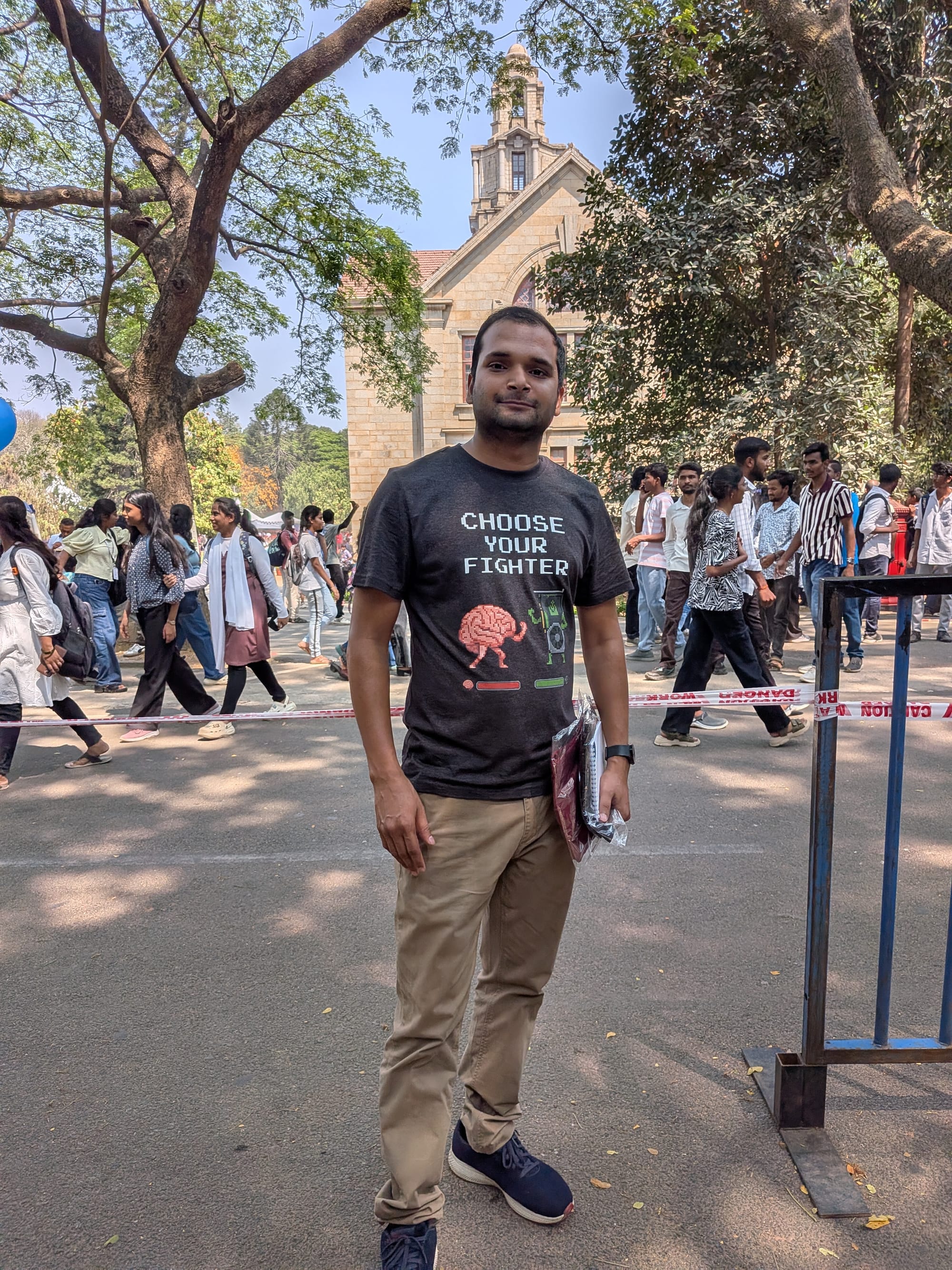
On a personal note: I'm thrilled to have won the ML Quiz during the event! 🏆 Nothing beats the feeling of nerd-sniping your way to a cool T-shirt.
The Technical Deep Dive 🧠
The sessions pushed past surface-level prompting into deep architectural and foundational challenges:
Reasoning & Benchmarking Integrity: One research work examined whether LLMs are "truth seekers" or merely "benchmaxing" on mathematical datasets. A highlight was the discussion on EsoLang-Bench and ISO-Bench — evaluating model generalisation across esoteric programming languages and real-world inference workloads respectively. Both have since been accepted at ICLR 2026 workshops, with EsoLang-Bench featured at the Logical Reasoning and ICBINB workshops.
Bio-AI & Toxicity (Nature Paper): A standout session focused on the lab's recent work published in Nature regarding drug toxicity. Using the hERG dataset and ToxPred, Rishikesh demonstrated how LLMs can be grounded for deep physical and biochemical research — a striking example of AI for science moving beyond benchmarks into real-world impact.
Efficiency & System Engineering: In the "Honey, I Shrunk the Models" session, Anant deconstructed COBRA (Pruning) and weight quantization techniques. The lab utilises Bayesian Optimisation and Knapsack algorithms to maximise memory allocation for matmuls — a beautifully practical application of combinatorial optimisation to the very unglamorous problem of making models run faster on less hardware.
Self-Healing Infrastructure (ORU'EL): Perhaps the most novel session applied physics to compute. By using the Arrhenius Equation to model thermal degradation and PINNets (Physics-Informed Neural Networks), Lossfunk is enabling proactive GPU failure detection systems — essentially giving data centres the ability to predict hardware death before it happens.
Agentic Intelligence & Memory: Vivek from IISc is exploring Dynamic Memory architectures — controlled by the model via Context Compaction and retrieval approaches, with tested forced compaction cycles — to solve long-horizon tasks. This work connects directly to Automated Stateful Specialisation for Adaptive Agent Systems, which landed at the ICLR 2026 main conference.
A Proven Track Record of Impact
The caliber of this lab is best reflected in its peer-reviewed output. In just the last 12 months, the Lossfunk team has secured:
- ⭐ 1 Paper @ ICLR 2026 Main Conference — Automated Stateful Specialisation for Adaptive Agent Systems
- ⭐ 1 Paper @ ACL 2025 Main Conference — IPO: Your Language Model is Secretly a Preference Classifier
- 2 Papers @ NeurIPS 2025 Workshops — on efficient reasoning and confidence signals for LLM reasoning
- 4 Papers @ AAAI 2026 Workshops — spanning AI consciousness, world models, bias, ethics, and AI for science
That's an remarkable output for an independent lab operating without the resources of a university or big tech backing.
What Lossfunk Actually Is
For those unfamiliar: Lossfunk is an independent research lab in Bangalore founded by Paras Chopra, who previously built Wingify (bootstrapped to $50M ARR before exiting). The lab's focus sits at the intersection of three big questions: how do intelligent systems adapt and generalise, what does creativity look like in artificial systems, and what can biology teach us about building better AI?
They run three programmes — a full-time Research Fellowship for pre/post-docs, a Research Internship for students, and the Residency (the programme whose graduation I attended) — a 6-week, on-site, curiosity-led exploration into AI and related topics. It's the kind of environment that produces researchers who ask genuinely hard questions rather than chasing leaderboard points.
The Lossfunk Ecosystem
Interaction with the team — including Paras, Aditya, Anant, and Vivek — showcased a culture of rigorous inquiry. Whether through their Visiting Residents programme or full-time foundational research, Lossfunk is providing the infrastructure and intellectual density for researchers to compete at a global level from India.
If you're serious about foundational AI research, this is the place to be in Bengaluru. Check them out at lossfunk.com or follow along on @lossfunk.