
Train Once, Forget Forever — The Race to Build AI That Actually Learns Continuously
Every AI model you use today was trained once, frozen in time, and slowly going stale. The world's top labs — Google, OpenAI, Anthropic, SSI — are now racing to fix this. Here's what's at stake and how they're approaching it.
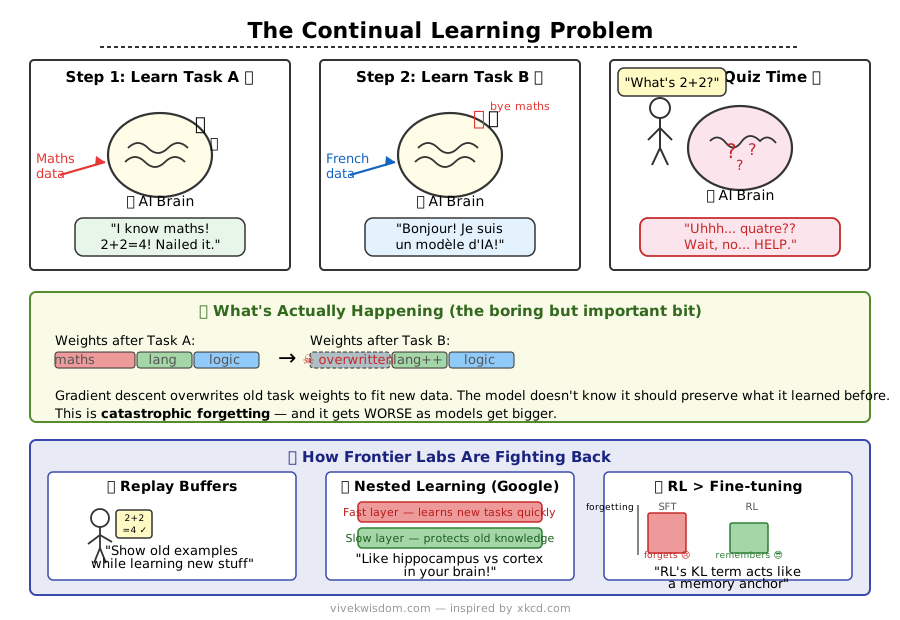
The Continual Learning Problem — an xkcd-style explainer
The Problem No One Talks About Enough
Every large language model you interact with today — GPT, Gemini, Claude — was trained on a massive dataset, frozen at a point in time, and shipped. That's it. It doesn't learn from your conversations. It doesn't update when the world changes. It forgets nothing because it never learned anything new in the first place.
But here's the deeper irony: when researchers do try to teach these models new things after training, they start forgetting what they already knew. This is the catastrophic forgetting problem — and it's arguably the most important unsolved challenge in AI right now.
In late 2025, the conversation around continual learning reached a boiling point. Andrej Karpathy publicly stated that current LLMs are "cognitively lacking" due to their inability to learn continuously, placing AGI roughly a decade away if this problem isn't cracked. Ilya Sutskever, at SSI (Safe Superintelligence Inc.), revealed his lab is working specifically on continual learning — calling it a 5 to 20 year research horizon. And Dario Amodei at Anthropic offered a more optimistic counter: every time AI has hit what felt like a "fundamental obstacle," researchers have found a way through.
The race is on. Here's the state of the field.
Why Catastrophic Forgetting Is So Hard
When a neural network learns Task B after learning Task A, the gradient updates that encode Task B tend to overwrite the weights responsible for Task A. The model doesn't selectively update — it rewrites. The result: by the time it's good at Task B, it's forgotten Task A almost entirely.
This isn't a niche edge case. It's a fundamental property of how gradient descent works on neural networks trained sequentially. And it gets worse at scale: research from Luo et al. (2025) demonstrated that forgetting actually worsens as model size grows, across decoder-only LLMs ranging from 1B to 7B parameters. Bigger isn't better when it comes to continual learning — at least not yet.
The core tension researchers are trying to resolve is what's called the stability-plasticity tradeoff: a model needs to be plastic enough to absorb new knowledge, but stable enough not to lose what it already knows. Get this balance wrong in either direction, and you either have a model that can't learn or one that can't remember.
What Frontier Labs Are Actually Doing About It
1. Google Research: Nested Learning (NeurIPS 2025)
The most architecturally novel approach came from Google Research at NeurIPS 2025. Their paper, "Nested Learning: The Illusion of Deep Learning Architectures," introduces a fundamentally different way to think about how models learn.
Rather than treating a neural model as a single continuous optimization process, Nested Learning frames it as a system of interconnected, multi-level learning problems optimized simultaneously. Crucially, the architecture and the training algorithm are treated as the same concept — just different "levels" of optimization, each with its own context flow and update rate.
The insight is elegant: by separating what changes fast (task-specific representations) from what changes slowly (general world knowledge), the model can acquire new skills without overwriting foundational capabilities. It's closer to how biological brains handle memory consolidation — fast learning in the hippocampus, slow consolidation into the cortex — than anything in standard deep learning.
2. The RL Surprise: Reinforcement Learning Is Shockingly Robust to Forgetting
One of the most counterintuitive findings of 2025 came not from a purpose-built continual learning technique, but from a closer look at standard training methods. Multiple research groups discovered that reinforcement learning (RL) is remarkably resistant to catastrophic forgetting — even without any explicit mechanisms like replay buffers or regularization — while supervised fine-tuning (SFT) tends to forget aggressively.
Why? Two mechanisms appear to be at play. First, the KL divergence term used in RL training acts as an implicit form of knowledge distillation, anchoring the model to its prior distribution and preventing wholesale overwriting of existing knowledge. Second, models trained with long chain-of-thought RL reasoning appear to build a more robust internal knowledge representation that's harder to erase.
There's also a more fundamental explanation rooted in optimization theory: RL's mode-seeking behavior (concentrating probability mass on the most likely outputs) turns out to be more stable under sequential updates than SFT's mode-covering behavior. The practical implication is significant — given that RL is already central to how frontier models are post-trained, this robustness to forgetting makes it a naturally important tool for building more generally capable systems.
3. Model Growth Strategies: Building on What You Already Know
Another promising direction involves using already-trained smaller models as foundations for larger ones, rather than training from scratch. The intuition: if you expand the model's capacity while preserving its existing weights, you reduce the risk of overwriting prior knowledge during new learning.
This approach tackles two problems at once — the computational cost of training large models from scratch, and catastrophic forgetting during continual updates. It's still early-stage research, but it points toward a paradigm where models grow incrementally rather than being periodically replaced with new, larger versions trained from zero.
4. Smarter Replay: Teaching Models to Remember Efficiently
Replay-based methods — where a model is periodically shown samples from prior tasks while learning new ones — are one of the oldest approaches to continual learning. But recent work like GeRe (General Replay) has made them more sophisticated. Rather than replaying task-specific examples, GeRe uses general-capability samples: examples that reinforce broad, transferable knowledge rather than narrow task memory.
The cognitive inspiration is direct: human memory doesn't replay episodic records of every task. It consolidates general principles. Training models to do something similar — retaining general capabilities rather than task-specific traces — shows measurable improvement in downstream robustness.
5. "Spurious Forgetting" — Rethinking What Forgetting Even Means
A conceptually important contribution from Zheng et al. (2025) challenges the standard framing of forgetting itself. Their research suggests that what often looks like knowledge loss in continual learning is actually task misalignment — the model still has the underlying knowledge, but its outputs have drifted away from the expected format or distribution of prior tasks.
This distinction matters a lot for how we evaluate and design continual learning systems. If the model "knows" something but can't demonstrate it correctly, the fix isn't more replay or regularization — it's better alignment between what the model represents and how it's evaluated. It also opens the door to lighter-weight interventions that realign rather than retrain.
The Bigger Picture: Why This Is an AGI-Level Problem
Continual learning isn't just a technical optimization — it's increasingly seen as a prerequisite for AGI. Ilya Sutskever's core thesis at SSI is that AGI won't be a static oracle trained once on trillions of tokens. It will be a continual learner: a system that improves through deployment, aggregates experience across millions of instances, and gets smarter the more it operates in the world. Humans can't merge memories across individuals. Models can. That asymmetry, Sutskever argues, is where the real acceleration happens — but only if the forgetting problem is solved first.
Demis Hassabis at Google DeepMind has made similar arguments, framing continual learning as essential to whether AI can eventually conduct independent research and programming autonomously. The Nested Learning work from Google Research is, in part, an operationalization of this belief.
The dominant paradigm today — pretrain on fixed data, post-train with RL, deploy — increasingly looks like a temporary solution rather than a permanent architecture. Frontier researchers are questioning whether the clean separation between training and deployment reflects how learning should actually work. The answer, increasingly, is no.
Where This Goes in 2026
There's no silver bullet yet. As Sebastian Raschka noted in his end-of-2025 review, there hasn't been a single dramatic breakthrough in continual learning — but the research momentum is unmistakable. The combination of RL's surprising anti-forgetting properties, Google's architectural rethinking via Nested Learning, and the growing consensus among frontier lab leaders that this problem is central to AGI suggests we're entering a period of rapid progress.
What to watch for:
- RL-based continual training pipelines becoming standard in frontier model post-training
- Architecture-level innovations that separate fast and slow learning streams
- Better benchmarks that distinguish genuine forgetting from spurious misalignment
- SSI's research direction becoming clearer as Sutskever's team publishes
For now, every AI model you use is still frozen in time. But for the first time in a while, the people trying to change that feel like they're closing in on something real.
References
- Google Research — Nested Learning: The Illusion of Deep Learning Architectures, NeurIPS 2025. research.google
- Cameron Wolfe — Continual Learning with RL for LLMs, Jan 2026. cameronrwolfe.substack.com
- Luo et al. (2025) — Mitigating Catastrophic Forgetting in Continual Learning through Model Growth. arxiv.org
- Zheng et al. (2025) — Spurious forgetting in continual LLM fine-tuning. arxiv.org
- GeRe (2025) — Towards Efficient Anti-Forgetting in Continual Learning of LLM via General Samples Replay. arxiv.org
- Sebastian Raschka — The State of LLMs 2025. magazine.sebastianraschka.com
- Wang ML Lab — Continual Learning of Large Language Models: A Comprehensive Survey, CSUR 2025. github.com
- spotintelligence.com — Introduction to Continual Learning. spotintelligence.com